Key Takeaway
In 2026, startup founders have four paths to an MVP: AI builders ($0-500, days), freelancers ($5K-50K, 1-3 months), agencies ($50K-500K, 3-6 months), and supervised AI builds ($9K-50K, 2-4 weeks). Choose AI builders for validation prototypes, supervised AI for production MVPs, and agencies only for complex regulated products.
MVP development has changed more in the last 18 months than in the previous decade. AI-assisted engineering, new build models, and dramatically compressed timelines have rewritten the rules for how startups go from idea to first product.
The stakes are high. Research from CB Insights and Demand Sage consistently shows 42% of startups fail because they built a product the market didn’t want — not because they ran out of money or lost to competitors, but because they built the wrong thing. A well-executed MVP is how you avoid that outcome: you validate before you overbuild.
If you’re a founder evaluating MVP development options in 2026 — whether you’re comparing agencies, considering AI tools, or wondering if you should build in-house — this guide covers the full landscape. Costs, timelines, approaches, mistakes to avoid, and how to choose the right MVP development company or service for your specific situation.
This is the hub page. Every MVP-related question gets answered here, with links to deeper dives where relevant.
What MVP Development Means in 2026
An MVP — minimum viable product — is the smallest version of your product that delivers enough value to attract real users and generate real feedback. It’s not a prototype. It’s not a mockup. It’s a functional product that people can use, pay for, and respond to.
In 2026, the definition hasn’t changed, but the execution has. Three shifts matter:
The timeline has compressed. A traditional MVP development agency or consultancy typically delivers in 3 to 6 months. With AI-assisted engineering under expert supervision, the same output now takes 1 to 4 weeks.
The cost floor has dropped. Professional software consultancies typically charge $100,000 to $200,000 for an MVP engagement. Expert-supervised AI building cuts that by 60 to 80%, with the same production-grade output.
The quality bar has risen. Users in 2026 expect production quality from day one. An MVP with obvious bugs, slow load times, or broken flows doesn’t get the benefit of the doubt. “It’s an MVP” is no longer an excuse for a poor user experience.
The net effect: MVP development is faster, cheaper, and needs to be better than it used to be. That’s a challenging combination, and it’s why choosing the right development approach matters more than ever.
Types of MVPs
Not every MVP needs to be a fully built software product. Understanding the spectrum helps you match your investment to your stage.
Concierge MVP
You deliver the product’s value manually, without building anything. A founder personally handles what the software would eventually automate. This validates demand before writing any code.
Cost: $0 | Timeline: Days | Best for: Pre-seed ideas you haven’t validated at all
Landing Page MVP
A landing page that describes the product and captures signups. No product behind it, just a value proposition and a waitlist. Measures whether people want what you’re describing.
Cost: $0-$500 | Timeline: 1-3 days | Best for: Testing positioning and demand before building
Prototype / Clickable Demo
A visual representation of the product that users can interact with. Built with tools like Figma, Lovable, or Bolt.new. Looks like a product but doesn’t have production infrastructure behind it.
Cost: $100-$2,000 | Timeline: 1-7 days | Best for: Investor demos, user testing, validating UX assumptions
Functional MVP (Production-Grade)
A working product with real authentication, real data storage, real integrations, and enough functionality to deliver genuine value. This is what most founders mean when they say “MVP” and what most MVP development companies and services build.
Cost: $5,000-$150,000+ | Timeline: 2 weeks to 6 months | Best for: Launching to real users, generating revenue, raising on traction
The rest of this guide focuses on the functional MVP — the version that actually ships to real users.
The 5 Approaches to Building an MVP
Approach 1: Build It Yourself
Best for: Technical founders with engineering experience
You write the code. You make the architecture decisions. You deploy and maintain it. Total control, zero external cost.
| Factor | Details |
|---|---|
| Timeline | 4-12 weeks (if you’re experienced) |
| Cost | $0 (your time) |
| Quality | Depends entirely on your skills |
| Risk | Slow if you’re learning; bias toward your own blind spots |
When this works: You’re an experienced engineer building a product in a domain you understand. The tech stack is straightforward. You have 2-3 months to dedicate.
When this doesn’t work: You’re a non-technical founder (see The Non-Technical Founder’s Guide to Building a Product in 2026). Or you’re a technical founder whose time is worth more on sales, fundraising, and strategy than on writing code.
Approach 2: Hire Freelancers
Best for: Founders with some technical knowledge who can manage a developer
You find a freelance developer (or small team) on Toptal, Upwork, or through referrals. You manage the project. They write the code.
| Factor | Details |
|---|---|
| Timeline | 4-12 weeks |
| Cost | $10,000-$50,000 |
| Quality | Highly variable — depends on who you hire |
| Risk | Project management burden on you; quality is unpredictable |
When this works: You have enough technical knowledge to evaluate work quality, you’ve found a developer with relevant experience (ideally through a referral), and you have time to manage the project.
When this doesn’t work: You can’t evaluate code quality, you’re hiring based on portfolio alone, or you don’t have time for daily project management.
Approach 3: Hire an MVP Development Agency
Best for: Funded startups with budgets above $50K
A traditional MVP development company assigns a team — typically a project manager, designer, and 1-3 engineers — to build your product. They manage the process. You review deliverables.
| Factor | Details |
|---|---|
| Timeline | 8-24 weeks |
| Cost | $50,000-$250,000+ |
| Quality | Generally reliable (varies by agency) |
| Risk | Cost overruns, scope creep, misaligned timelines |
When this works: Your MVP is complex (multi-platform, heavy integrations, regulatory requirements), you have budget, and you want a hands-off experience with a managed team.
When this doesn’t work: Your budget is under $50K, your timeline is under 8 weeks, or you’ve been burned by agency projects that took twice as long and cost twice as much as estimated.
Approach 4: Use AI Builder Tools
Best for: Idea validation and prototyping (not production MVPs)
Tools like Bolt.new, Lovable, and Replit generate functional applications from text descriptions. Fast. Cheap. Limited in production quality.
| Factor | Details |
|---|---|
| Timeline | Hours to days (prototype) |
| Cost | $20-$200/month |
| Quality | Prototype-grade — not production-ready |
| Risk | You’ll need to rebuild for production |
When this works: You want to validate an idea for under $200 before investing in a real build. See Lovable vs. Bolt vs. Having It Built For You for a detailed comparison.
When this doesn’t work: You need real users handling real data and making real payments. AI builder tools produce prototypes, not products. A documented limitation: both Lovable and Bolt lose context after 15-20 iterations, frequently introducing bugs when modifying existing features. Complex applications require handoff to traditional development, at which point the “savings” disappear.
Approach 5: Expert-Supervised AI Building (MVP as a Service)
Best for: Founders who want production quality at AI speed
A new category of MVP development services where senior engineers use AI agents to build production-grade products. The AI handles code generation volume. The engineers handle architecture, security, quality, and judgment.
| Factor | Details |
|---|---|
| Timeline | 1-4 weeks |
| Cost | $5,000-$50,000 (outcome-based) |
| Quality | Production-grade from day one |
| Risk | Trusting external team; newer category with fewer providers |
When this works: You’ve validated your idea and need a production MVP fast. Your budget is $5K-$50K. You don’t want to manage the build process.
When this doesn’t work: You want full control over every technical decision, or your MVP is so complex it requires a dedicated team over many months.
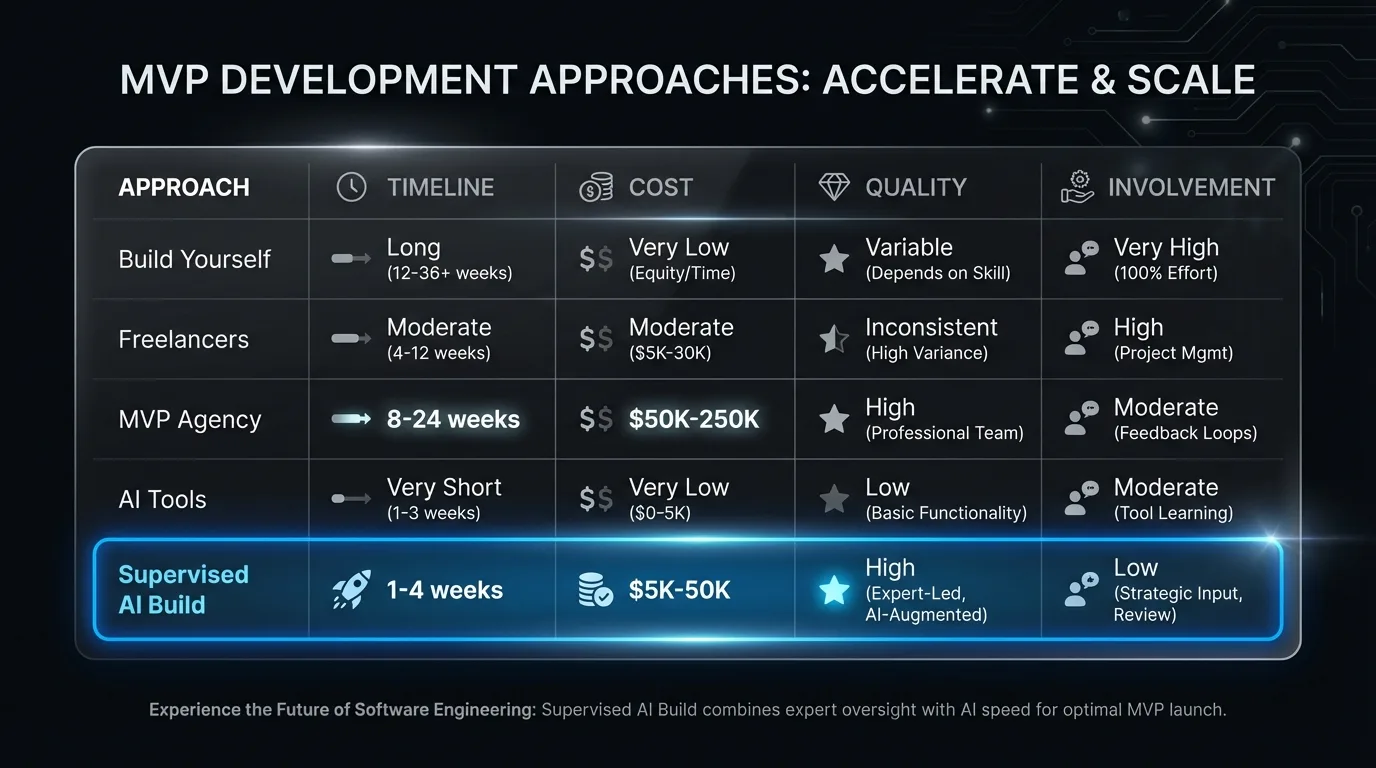
Summary: All 5 Approaches
| Approach | Timeline | Cost | Quality | Your Involvement |
|---|---|---|---|---|
| Build yourself | 4-12 weeks | $0 | Variable | Full-time |
| Freelancers | 4-12 weeks | $10K-$50K | Variable | High (project management) |
| MVP agency | 8-24 weeks | $50K-$250K+ | Reliable | Medium (reviews + decisions) |
| AI tools | Hours (prototype) | $20-$200/mo | Prototype only | Medium (you build it) |
| Supervised AI build | 1-4 weeks | $5K-$50K | Production-grade | Near zero |
How to Choose an MVP Development Company
If you’re evaluating MVP development agencies or services, these are the factors that separate good providers from bad ones.
1. Ask for live products, not portfolios
Portfolios show screenshots. Screenshots don’t tell you if the product actually works, performs well, or handles edge cases. Ask for URLs of products they’ve built that are currently live and serving real users. Use them. Break them. That tells you more than any case study.
2. Understand their pricing model
| Pricing Model | How It Works | Risk |
|---|---|---|
| Hourly billing | Pay per hour of developer time | Project takes longer = you pay more. Misaligned incentive. |
| Fixed project price | Pay a set amount for defined scope | Better, but scope changes get expensive. Watch for change order culture. |
| Outcome-based | Pay for the delivered product, not time spent | Best alignment — provider is incentivized to ship fast and well. |
Outcome-based pricing is the strongest signal that an MVP development company is confident in their ability to deliver.
3. Evaluate their discovery process
Good providers invest time understanding what you need before quoting. Great providers produce a structured PRD (product requirements document) as part of the process. Red flag: a company that quotes a price based on a 30-minute call without detailed requirements.
4. Ask about post-launch
What happens when you need changes after launch? Can you maintain the codebase yourself? Do they offer ongoing support? Is the code documented? Can you hire your own developer to take over? You don’t want to be locked in.
5. Check the technology decisions
Ask what stack they recommend and why. If they build every project on the same stack regardless of requirements, that’s a template factory, not a development partner. If they recommend a stack based on your product’s specific needs, that’s engineering judgment.
MVP Development Cost Breakdown
Costs vary dramatically based on approach and complexity. Here’s what to expect in 2026.
By product complexity
| Complexity | Description | Agency Cost | Supervised AI Build |
|---|---|---|---|
| Simple | CRUD app, basic auth, 5-10 screens | $30K-$80K | $5K-$15K |
| Moderate | SaaS with payments, dashboards, API integrations | $80K-$150K | $15K-$35K |
| Complex | Marketplace, multi-tenant, real-time features | $150K-$300K+ | $35K-$75K |

What drives cost up
- Multiple user roles — admin, customer, vendor each add complexity
- Payment processing — Stripe integration with subscriptions, invoicing, refunds
- Third-party integrations — each API connection adds development and testing time
- Real-time features — chat, notifications, live updates require WebSocket infrastructure
- Regulatory compliance — HIPAA, SOC 2, GDPR add security and documentation requirements
What keeps cost down
- Clear requirements — ambiguity is expensive. A detailed PRD before development starts can reduce costs by 30-50%.
- Fewer platforms — start with web only. Add mobile later when you’ve validated demand.
- Standard patterns — auth, payments, CRUD operations are well-solved problems. Custom solutions to standard problems are expensive and unnecessary.
- Outcome-based pricing — removes the incentive for the provider to extend the timeline.
Timeline Expectations
Realistic timelines by approach
| Approach | Discovery | Development | Testing + Deploy | Total |
|---|---|---|---|---|
| Agency | 2-4 weeks | 6-16 weeks | 2-4 weeks | 10-24 weeks |
| Freelancer | 1-2 weeks | 4-10 weeks | 1-2 weeks | 6-14 weeks |
| Supervised AI build | 2-5 days | 1-3 weeks | 2-5 days | 2-4 weeks |

Why timeline matters beyond shipping date
Speed isn’t just operationally convenient. Reducing time-to-market by 5% can increase return on investment by 13%, according to product development research from TCGen. Every month of delay carries a real financial cost, not just opportunity cost, but compounding disadvantage as competitors iterate and your window narrows.
What causes delays
- Unclear requirements. If the provider doesn’t know exactly what to build, they build the wrong thing and rebuild. This is the #1 cause of timeline overruns.
- Scope creep. Adding features during development extends timelines linearly. Each “one more thing” adds days or weeks.
- Feedback loops. If it takes you a week to review a deliverable, you add a week to the project for every review cycle.
- Integration surprises. Third-party APIs don’t always behave as documented. Budget buffer time for integration debugging.
MVP Development by Industry
Different industries have specific MVP requirements that affect scope, cost, and timeline.
SaaS Products
SaaS MVPs need subscription billing, multi-tenancy, role-based access control, and API infrastructure from day one. These aren’t optional features, they’re structural requirements. A SaaS MVP without proper billing integration isn’t viable.
Typical cost: $8K-$75K (supervised AI build) or $40K-$200K (agency) depending on complexity.
For SaaS-specific MVP considerations, see our Launchpad overview.
Marketplaces
Two-sided marketplaces have the cold-start problem: you need supply to attract demand, and demand to attract supply. The MVP needs to solve one side manually while building infrastructure for the other. Payment splitting (paying suppliers their share), review systems, and search/matching algorithms add complexity beyond a standard CRUD application.
Typical cost: $20K-$75K (supervised AI build) or $80K-$250K (agency).
AI Products
Products with AI at their core add a model integration layer, whether you’re using OpenAI, Anthropic, or custom models. The MVP needs prompt engineering, output quality management, usage-based billing (tokens are expensive), and fallback handling for when the AI model returns unexpected results. The AI API integration itself is straightforward. Managing cost, quality, and reliability at production scale is the engineering challenge.
Typical cost: $10K-$50K (supervised AI build) or $50K-$150K (agency).
Internal Tools
Internal tools for your own team have lower UX requirements but the same data integrity and reliability needs. The advantage: your users are your employees, so you can iterate based on direct feedback and tolerate rougher edges than a customer-facing product.
Typical cost: $5K-$25K (supervised AI build) or $25K-$80K (agency).
What a Good MVP Doesn’t Include
Knowing what to cut is as important as knowing what to build. A good MVP intentionally excludes:
- Admin dashboards beyond the basics. You can manage early operations with database queries and simple admin pages. A full analytics dashboard with charts, exports, and custom reports is a V2 feature.
- Multiple platforms. Launch web-only. A native iOS and Android app can follow once you’ve validated demand on the web. Building three platforms simultaneously triples your timeline without tripling your learning.
- Notification systems. Email notifications are sufficient for an MVP. Push notifications, in-app notification centers, and notification preferences are V2 features.
- Advanced search. Basic search (exact match, simple filters) is enough for an MVP. Full-text search, faceted navigation, and search analytics come later.
- Internationalization. Launch in one language for one market. Multi-language support is engineering work that doesn’t help you validate product-market fit.
The discipline of cutting features is what separates an MVP that ships in 3 weeks from one that ships in 3 months. Every feature you add extends the timeline and delays learning from real users.
Common MVP Development Mistakes
1. Building too much
The most expensive mistake, and the most common. 42% of startups fail because they built something the market didn’t want. Not because they ran out of money first. Because they over-built before they validated.
You don’t need 50 features for launch. Identify the 3-5 features that deliver the core value proposition and ship those. Everything else can wait for version 2.
A good rule: if a feature doesn’t directly help a user accomplish the primary task your product solves, cut it from the MVP.
2. Choosing based on hourly rate
A developer at $50/hour who takes 3 months costs $24,000 and delivers mediocre code. An engineer at $200/hour who takes 2 weeks costs $16,000 and delivers production-grade code. The cheap option was more expensive and worse.
Evaluate total project cost and quality of output, not hourly rate.
3. Skipping the PRD
Starting development without a written product requirements document is like building a house without a blueprint. You’ll get a building — it just won’t be the one you wanted. Invest 3-5 days in a detailed PRD before any code is written.
4. Prototype-as-product
Using a Bolt.new or Lovable prototype as your production product. AI-generated prototypes are for validation. They lack the security, scalability, and reliability that real users require. Building on a prototype’s codebase almost always costs more than starting fresh with proper architecture.
5. Ignoring post-launch
Your MVP launches. Users sign up. They find bugs. They request features. They need support. If you haven’t planned for iteration after launch, your MVP becomes a dead product within weeks. Budget time and money for the first 30 days after launch.
6. Over-building v1
The opposite of mistake #1 is building too little. But in practice, over-building is far more common. Founders add “just one more feature” repeatedly until the MVP has 20 features and a 6-month timeline. The discipline check: for each feature, ask “would our first 10 customers pay for this product without this feature?” If yes, cut it.
7. Choosing the wrong MVP development partner based on portfolio alone
A portfolio of beautiful screenshots tells you nothing about code quality, deployment practices, or post-launch reliability. Ask for live URLs. Ask for references from technical people who’ve reviewed their code. Ask what happens when something breaks at 2am on a Saturday. The answers matter more than the screenshots.
The AI-Supervised Approach to MVP Development
This is the approach that’s disrupting the traditional MVP development agency model in 2026. Here’s how it works:
Step 1: Describe what you need. Not a technical specification. A clear description of the problem you’re solving, who you’re solving it for, and what the product should do.
Step 2: Receive a PRD and fixed quote. The team produces a structured product requirements document and a fixed price. No hourly estimates. No “it depends.” A specific deliverable for a specific price.
Step 3: AI agents build, supervised by senior engineers. AI handles the volume — generating code, building interfaces, wiring integrations. Senior engineers handle the judgment — architecture decisions, security implementation, code review, quality assurance. Every line of code is supervised.
Step 4: Receive a production-grade product. Deployed, tested, monitored. Authentication, database, APIs, error handling, deployment pipeline — all included. Not a prototype you need to rebuild. A product you can launch.
The model works because AI-assisted development genuinely compresses timelines. A controlled study of 95 professional developers found that developers using AI coding assistance completed tasks 55% faster — 1 hour 11 minutes versus 2 hours 41 minutes without it. When senior engineers are the ones supervising, the quality gains compound: experienced judgment applied at AI speed is the core of the model. The cost savings and timeline compression pass through to you.
Checklist: Are You Ready to Build?
Before you engage any MVP development company or service, make sure you can answer these questions:
- Problem clarity. Can you describe the problem you’re solving in one sentence?
- User clarity. Can you describe who has this problem and why they’d pay to solve it?
- Validation signal. Do you have evidence of demand? (waitlist signups, LOIs, customer interviews, competitor traction)
- Core features. Can you list the 3-5 features your MVP needs and nothing more?
- Success metric. What does success look like 30 days after launch? (users, revenue, engagement)
- Budget range. Do you know what you can spend?
- Timeline. Is there a deadline driving this? (funding round, market window, competitive pressure)
If you can answer all 7, you’re ready to build. If you can’t answer the first 3, you need to validate before you build — and that’s where prototyping tools earn their keep.
The Bottom Line
MVP development in 2026 is faster, cheaper, and held to a higher quality standard than ever before. The traditional model — 3-6 months, $50K-$150K, managed by an agency — still exists and still works for complex projects. But it’s no longer the only path.
For founders who want production-grade MVPs in weeks instead of months, supervised AI building has emerged as the most efficient approach. Not because AI replaces engineers, but because AI makes expert engineers fast enough to build production products on startup timelines and budgets.
The right MVP development approach depends on your stage, budget, and complexity. But the one decision that applies to everyone: don’t launch a prototype and call it an MVP. Build production-grade from the start, or invest in getting there before your first user signs up.
Chrono Launchpad is built for founders who want production-grade MVPs without managing the build. Fixed price, senior engineers, weeks not months. Get a quote.