Key Takeaway
Canadian tech companies leave $200K-$500K per year in SR&ED credits unclaimed because they can't document R&D work after the fact. Engineers don't write contemporaneous records, and retroactive documentation is expensive and incomplete. The fix is automated evidence collection from tools your team already uses: Git, Jira, Slack.
There’s a gap between what your company could claim and what it actually does claim.
For most tech companies, that gap is between $200K and $500K per year.
Some companies don’t file SR&ED claims at all, so the gap is 100%. Other companies file but conservatively. Either way, the math is stark: this is money your company is entitled to that you’re not collecting.
The Typical Math

Take a Series B SaaS company with 25 engineers at $200K loaded cost each:
- Total engineering spend: $5M per year
- Estimated R&D work: 35% of engineering = $1.75M
- Potential credit (35% refundable): $612,500
But what actually happens:
- If you file nothing: Gap of $612,500
- If you file conservatively: Claim 60% of eligible = Gap of $245,000
- If you hire a consultant: Pay $30K, claim 80% = Net of $460,000, but gap of $152,500
Across Multiple Years

If your company has never claimed SR&ED in 5 years:
- Year 1-5 gaps: $300K → $450K annually
- Total 5-year gap: $1.825 million
You can claim back 5 years. This is recoverable money.
Why the Gap Exists
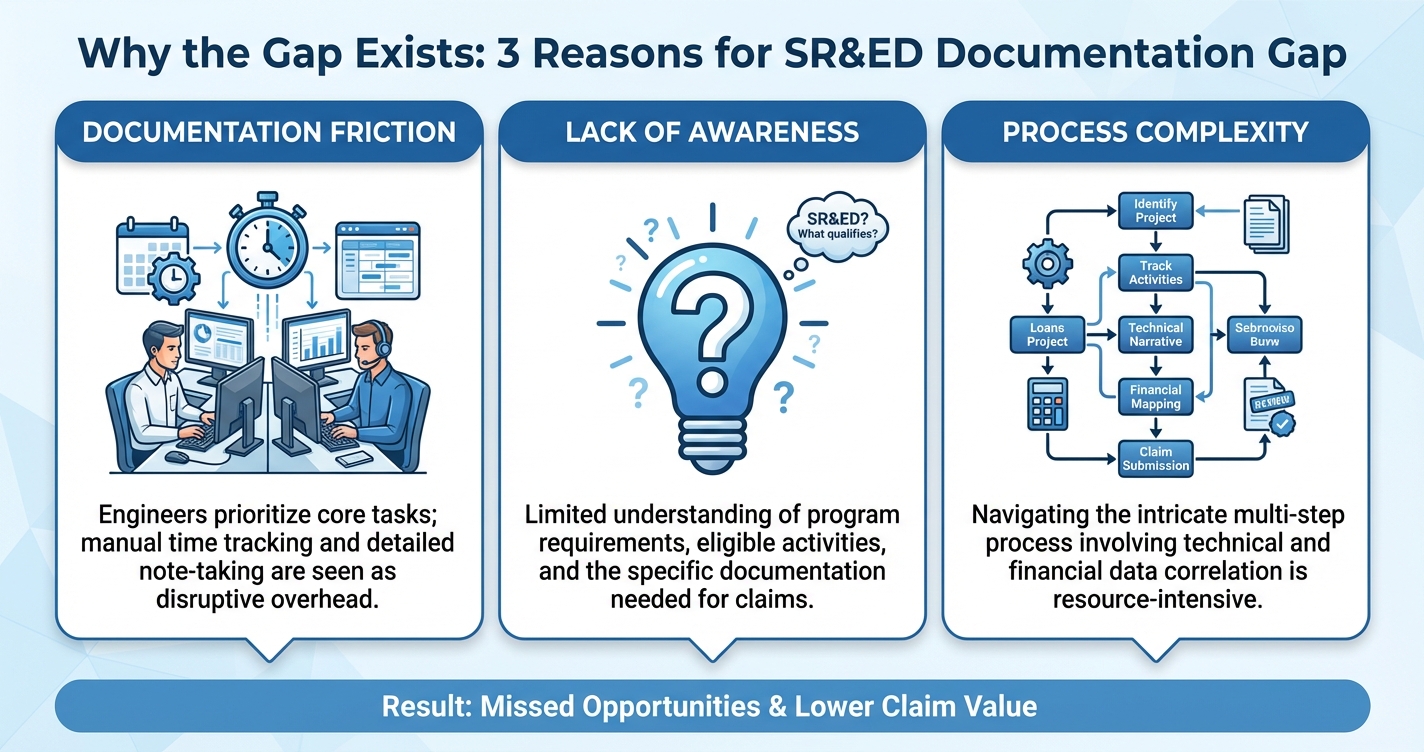
- Documentation friction — Engineers don’t naturally track SR&ED time
- Lack of awareness — Many companies don’t know the program exists
- Process complexity — Filing involves multiple steps and coordination
The Automation Trend
Companies are moving from consultant-driven documentation to software-driven automation. This closes the gap—companies using automation tools claim 85-95% of eligible work instead of 50-60%.
What To Do
If you’ve never claimed, get a rough estimate and consider filing amended returns for past 5 years. If you claim conservatively, review what eligible work you’re leaving out. If you claim fully, continue documenting rigorously.
The gap isn’t permanent. Close it, and you recover substantial money.